Credit Management self-assessment

Credit Management calculators › Self-assessment

Free self-assessment · 3 minutes · SMEs, mid-sized companies and groups

How mature is your Credit Management?

Designed for finance departments and credit managers handling a large portfolio of customers and invoices. Answer 12 questions on customer risk, dunning, disputes, credit insurance and steering, and get a score out of 100, your profile by area and concrete recommendations.

Question 1 of 12

Why measure the maturity of your Credit Management?

Credit Management, or customer credit management, covers all the practices that let a company sell safely and get paid on time: risk assessment, credit limits, credit insurance, dunning, dispute management, collections and accounts receivable steering.

Measuring your maturity in each of these areas shows where the quickest gains lie: cash tied up, avoidable bad debt, time lost on manual tasks.

The 5 areas assessed

  • Customer risk: assessment at account opening, credit limits and monitoring;
  • Dunning & collections: how reminders are triggered and actions prioritised;
  • Disputes & collaboration: dispute handling and involvement of sales and sales administration;
  • Credit insurance: matching cover and exposure, meeting policy obligations;
  • Steering & tools: DSO tracking, KPIs and tools used.

The 4 maturity levels

  • Initial (0–39): practices rely on people and files, risk is endured rather than anticipated;
  • Structuring (40–59): processes exist but remain manual and only partly monitored;
  • Controlled (60–79): processes are tooled and steered, with further gains possible through automation and collaboration;
  • Optimised (80–100): Credit Management is automated, data-driven and shared across the company.

Frequently asked questions

Are my answers stored?

No. The assessment is calculated directly in your browser: no answer is sent to or kept by Hoopiz.

Who is this self-assessment for?

Finance departments, credit managers and heads of collections at SMEs, mid-sized companies and groups. The questions cover practices specific to organisations that track a large number of customers and invoices: credit limits, dunning scenarios, credit insurance, collaboration with sales teams.

What should I do after the assessment?

Start with the priorities identified: these are the areas where the gap with best practice is largest. A Hoopiz demo then shows you how digitisation helps you progress in each of them.

How is the score calculated?

Each answer corresponds to a practice level, from 0 to 3. Each area’s score is the average of its answers, converted to a score out of 100; the overall score is the average of the areas assessed. If you have no credit insurance, that area is not taken into account.

Take it to the next level

See how SMEs, mid-sized companies and groups structure, automate and steer their Credit Management with Hoopiz.

Book a demo

Read More
27 October 2026
Close up Indian woman planning budget, using calculator and laptop

Cash gain simulator

Credit Management calculators › Cash gain simulator

Free simulator

Simulate your cash gains with Credit Management software

Cash released by a lower DSO, financing costs saved, bad debt avoided, time freed up for your teams: estimate in seconds the return on investment of collections and customer risk management software.

€
€
10 days: order of magnitude observed among our mid-sized and group customers after 12 months.
%
Rate of your overdraft, factoring or credit line.
€
Losses on receivables for the year.
FTE
Full-time equivalents (credit managers, collection officers, sales administration…).

Cash released

–

Current DSO → target DSO–
Financing costs saved / year–
Bad debt avoided / year (−30%)–
Recurring annual gain–
Time freed up for your teams (−30%)–

Conservative assumptions: cash calculated on revenue excl. VAT; −30% bad debt and −30% processing time are orders of magnitude observed among our mid-sized and group customers after 12 months of use. Results vary depending on the starting point.

Where do the gains of Credit Management software come from?

Credit Management software, also called collections and customer risk management software, acts on four measurable levers:

  • Cash: by reducing DSO (days sales outstanding), it brings back cash tied up with your customers;
  • Financing costs: this released cash reduces your short-term financing needs (overdraft, factoring, credit lines);
  • Bad debt: risk assessment, monitoring and early reminders reduce uncollectable receivables;
  • Productivity: automated reminders and prioritisation free up time for analysis and high-stakes cases.

How is the cash released calculated?

Each day of DSO represents one day of sales tied up with your customers:

Cash released = (Annual revenue excl. VAT ÷ 365) × Days of DSO saved

Example

For €100M of revenue excl. VAT, one day of DSO represents about €274,000. Reducing DSO by 10 days therefore releases €2.7M of cash. Financed at 4%, this amount represents about €110,000 of financing costs saved every year.

Calculating on revenue excluding VAT is deliberately conservative: as your receivables include VAT, the actual cash gain is generally higher.

One-off gain and recurring gain

The cash released is a one-off gain: once DSO is reduced, the cash remains available as long as DSO is maintained. Financing costs saved and bad debt avoided are recurring gains, repeated every year. The sum of both is what should be compared with the cost of Credit Management software.

How to reduce DSO in practice

  • Structured dunning: scenarios tailored to each customer’s profile and risk, with pre-due reminders;
  • Prioritisation: an agenda that focuses collection officers on the highest-stakes cases;
  • Fast dispute resolution, together with sales and sales administration;
  • Controlled risk: credit limits, behavioural scoring, well-managed credit insurance;
  • Steering: DSO, aged balance and delays tracked by company, segment and salesperson.

Start by measuring your baseline with our DSO calculator, then see how Hoopiz automates these levers.

Frequently asked questions

How quickly does Credit Management software pay for itself?

It depends on your starting point, your receivables volume and the scope deployed. For a company managing a large volume of customers and invoices, the cash released by a lower DSO generally far exceeds the annual cost of the software. In a demo, we show you which levers Hoopiz acts on for your organisation.

Why −10 days of DSO?

This is the order of magnitude we observe among our mid-sized and group customers after 12 months of using Hoopiz. It depends on the starting DSO and on the organisation: you can adjust the target reduction in the simulator.

Is the cash released an annual gain?

No: it is a one-off cash gain, available as long as DSO is maintained at its new level. The recurring annual gains are the financing costs saved on this cash and the bad debt avoided.

Does the time freed up mean headcount reductions?

That is not the goal. Time saved on repetitive tasks (reminders, searches, reconciliations) is reinvested in risk analysis, complex cases and relationships with customers and sales teams.

What data is needed for an accurate estimate?

Your aged balance, monthly revenue, bad debt and team organisation are enough for a first estimate. These elements are reviewed with you during the scoping of a Hoopiz project.

Turn this simulation into results

See how SMEs, mid-sized companies and groups release cash and reduce bad debt by digitising their Credit Management with Hoopiz.

Book a demo
Read More
27 October 2026
Close up Indian woman planning budget, using calculator and laptop

True cost of bad debt calculator

Credit Management calculators › True cost of bad debt

Free calculator

Cost of bad debt: how much extra revenue do you need to make up for it?

An uncollectable receivable costs more than its amount: to offset it, your sales teams must sell far more. Calculate the real effort in revenue and in days of activity.

€
A single receivable, or your total bad debt for the year.
%
€
Reminders, bailiff, lawyer, internal time… (optional)
€
To express the effort in days of activity.

Revenue needed to offset the loss

–

Total loss (unpaid + costs)–
Sales effort (× unpaid amount)–
Equivalent in days of activity–
Losses avoided with −30% bad debt–

−30%: order of magnitude observed among our mid-sized and group customers after 12 months of using Hoopiz; results vary depending on the starting point.

What is compensating revenue?

When a receivable becomes uncollectable, meaning it is highly unlikely the customer will ever pay, the company loses not only the margin on the sale but also the cost of the goods or services already delivered. To get back to the same net result, it must generate additional revenue, known as compensating revenue.

This effort is almost always underestimated: with a net margin of a few percent, every euro lost must be offset by tens of euros of additional sales.

How to calculate it

Compensating revenue = (Unpaid amount excl. VAT + collection costs) ÷ Net margin rate

Example

A company with a 4% net margin suffers €250,000 of bad debt and spends €15,000 on collection. To offset this €265,000 loss, it must generate 265,000 ÷ 0.04 = €6.6M of additional revenue, almost 27 times the unpaid amount.

What bad debt really costs

  • The outright loss of the receivable, and therefore of the cost already incurred;
  • Collection costs: team time, reminders, formal notices, bailiffs, lawyers, proceedings;
  • The cost of cash: for months, the receivable tied up cash that had to be financed;
  • The opportunity cost: sales time spent making up for losses rather than growing the business.

Late payment penalties in France

Between businesses in France, any late payment automatically triggers late payment interest and a fixed €40 collection fee per invoice. Unless your terms state a rate, the applicable rate is the ECB rate plus 10 points, i.e. 12.40% in the second half of 2026; a contractual rate cannot be lower than three times the legal interest rate (8.25% in the second half of 2026). These amounts deter late payment but do not offset an uncollectable receivable.

How to prevent bad debt

The best way to reduce compensating revenue is to avoid the default in the first place:

  • Assess the risk of every customer at account opening and set credit limits;
  • Monitor changes in risk and payment behaviour, with alerts;
  • Secure large exposures with credit insurance, while meeting your policy obligations;
  • Send reminders early and in a structured way, and resolve disputes quickly;
  • Block orders from risky customers, together with your sales teams.

Credit Management software such as Hoopiz brings all these levers together in a single platform.

Frequently asked questions

What is the difference between an unpaid invoice, a doubtful debt and a bad debt?

An unpaid invoice is one not settled by its due date. It becomes doubtful when there is a serious risk it will not be recovered (long delay, dispute, customer in difficulty), and a bad debt when it is highly unlikely to be paid, for example after insolvency proceedings have closed.

Why use net margin rather than gross margin?

Net margin measures what the company actually keeps from each euro sold once all costs are paid. It therefore determines the sales volume needed to rebuild a lost result. Using gross margin would underestimate the effort.

How much late payment interest can I claim in France?

Between businesses, interest is calculated on the amount due, at the rate stated in your terms or, failing that, at the ECB rate plus 10 points (12.40% in the second half of 2026), pro rata to the days of delay. A fixed €40 fee per late invoice is added.

Is credit insurance enough to protect yourself?

It compensates part of the insured receivables, provided you meet the policy obligations (notifications, deadlines, limits). It does not cover uninsured customers or exposures above the insured limit: it must go hand in hand with active risk and collection management.

How can bad debt be reduced for good?

By combining risk assessment at account opening, continuous monitoring, well-managed credit insurance and structured dunning. Among our mid-sized and group customers, we see on average −30% bad debt after 12 months of using Hoopiz (order of magnitude, depending on the starting point).

Is bad debt weighing on your results?

See how SMEs, mid-sized companies and groups anticipate customer risk and reduce their bad debt with Hoopiz.

Book a demo

Read More
27 October 2026
Close up Indian woman planning budget, using calculator and laptop

DSO calculator

Credit Management calculators › DSO calculator

Free calculator

DSO calculator: how many days to turn your sales into cash?

Calculate your DSO (Days Sales Outstanding) using the accounting or the count-back method, measure your average payment delay and the cash a lower DSO would release.

€
Outstanding customer balance at the calculation date (overdue and not yet due).
€
The share of receivables past due and unpaid at the calculation date. It gives an accurate average delay, even when payment terms vary from one customer to another.

Revenue incl. VAT for recent months (most recent first)

Each month counts as 30 days. Add months if your receivables exceed 6 months of sales.

Your DSO

–days

0 d45 d90 d120 d +
Average payment delay–
Collectable sales incl. VAT per day–
Cash released with −10 days of DSO–

What is DSO?

DSO (Days Sales Outstanding) measures the average number of days a company needs to collect payment for its credit sales. It is the key indicator of accounts receivable performance: the higher it is, the more cash is tied up with your customers and the higher your working capital requirement.

Tracked over time, DSO reveals how effective your collections are, the quality of your invoicing and your customers’ payment behaviour.

How to calculate DSO

1. The accounting method

This is the most widely used method. It compares trade receivables with revenue over a period:

DSO = (Trade receivables incl. VAT ÷ Revenue incl. VAT for the period) × Number of days in the period

Example

Receivables of €22M incl. VAT, quarterly revenue of €30M incl. VAT: DSO = (22 ÷ 30) × 90 = 66 days.

Simple and fast, it does however smooth out variations in activity: with seasonality or strong growth, it can over- or underestimate the actual delay.

2. The count-back method

More accurate, it “exhausts” the receivables balance by successively deducting the revenue of the most recent months until the balance is fully covered:

  1. deduct the last month’s revenue from receivables: if a balance remains, count 30 days;
  2. continue with the previous month, and so on;
  3. for the last month, count only the fraction of the month matching the remaining balance.
Example

Receivables of €22M; sales of €11M last month, €10M the month before, €9.5M the month before that. 22 − 11 = 11 (30 days); 11 − 10 = 1 (30 days); 1 ÷ 9.5 × 30 ≈ 3 days. DSO ≈ 63 days.

This method better reflects reality when activity varies from month to month. It is the one we recommend for monthly steering.

How to interpret your DSO

A DSO is neither good nor bad in absolute terms: compare it first with the payment terms you grant. The gap between the two is your average payment delay, a direct measure of collection effectiveness.

With the count-back method, the calculator measures this delay from your overdue receivables: it compares your DSO with the DSO of your not-yet-due receivables alone. The result stays accurate even when the payment terms granted vary from one customer to another.

  • Compare it with your payment terms: in France, between businesses, agreed terms cannot in principle exceed 60 days from the invoice date, or 45 days end of month (specific rules apply in some sectors).
  • Track the trend over a rolling 12 months rather than a single value.
  • Stay consistent: receivables and revenue both including VAT, same method every month.
  • Break it down by segment (company, region, salesperson, customer) to find where to act.

How to reduce your DSO

Every day of DSO saved releases the equivalent of one day of sales in cash. The most effective levers:

  • Assess risk at account opening and set appropriate credit limits;
  • Invoice quickly and accurately, as a disputed invoice is often the start of a delay;
  • Send structured reminders, before and on the due date, with scenarios suited to each customer profile;
  • Resolve disputes collaboratively with sales and sales administration;
  • Steer with KPIs: aged balance, DSO by segment, promises to pay.

This is exactly what Credit Management software such as Hoopiz automates: among our mid-sized and group customers, we see on average −10 days of DSO after 12 months of use (order of magnitude, depending on the starting point).

Frequently asked questions about DSO

What is the difference between DSO and payment terms?

Payment terms are what you contractually grant your customers (for example 45 days). DSO measures the time actually taken to collect your sales. The gap between the two is the average payment delay.

What is a good DSO?

A good DSO is close to your contractual payment terms: a low average delay means your customers pay on time. It depends heavily on the sector and commercial terms; the trend over time matters more than a single value.

Should DSO be calculated excluding or including VAT?

Trade receivables include VAT, so they must be compared with revenue including VAT. Mixing receivables including VAT with revenue excluding VAT overstates DSO by about 20% with a 20% VAT rate.

Accounting or count-back method: which should I choose?

The accounting method is quick and fine for an estimate. The count-back method is more accurate when activity varies from month to month (seasonality, growth): it is best suited to monthly steering.

How often should DSO be calculated?

Ideally every month, on a fixed date, tracking the trend over a rolling 12 months and by segment. Credit Management software calculates it automatically from your accounting data.

What is the link between DSO and cash?

Each day of DSO represents roughly one day of sales including VAT tied up with your customers. Reducing DSO by 10 days therefore releases the equivalent of 10 days of revenue in cash, with no additional financing.

Is your DSO costing you cash?

See how SMEs, mid-sized companies and groups reduce their DSO for good by digitising their Credit Management with Hoopiz.

Book a demo
Read More
27 October 2026

Credit Management calculators

Resources

Credit Management calculators and tools

Measure your DSO, the true cost of your bad debt, the cash gains within reach and the maturity of your Credit Management. Free, no sign-up, designed for finance departments and credit managers.

What if these calculations were automatic?

With Hoopiz, DSO, aged balance, risk and dunning are tracked continuously. Discover the platform in a demo.

Book a demo

Read More
27 October 2026

FAQ

FAQ

All your questions about Credit Management with Hoopiz

Features, ERP integration, credit insurance, security, deployment, pricing and hoopiOne AI: answers to the questions finance departments and credit managers ask us.

No question matches your search. Ask an expert directly →

Hoopiz & Credit Management

What Hoopiz does, and who it is for.

What is Hoopiz?

Hoopiz is an all-in-one Credit Management software, delivered as SaaS. A single platform brings together accounts receivable steering, customer risk assessment and monitoring, credit insurance management, dunning and collections and dispute management.

The solution is designed and supported by Credit Management experts with more than 30 years of experience. Over 750 companies use it to secure their revenue and get paid faster.

My ERP already sends payment reminders: why use Credit Management software?

ERP modules are generally limited to sending reminders. Hoopiz is true Credit Management software: it brings together risk, exposure, payment behaviour, credit insurance and collections in one platform, with tailored dunning scenarios, collaborative dispute management and KPI-driven steering.

The results are stronger, and so are the options for organising your teams. Your ERP remains your accounting system of record: Hoopiz connects to it and can even send decisions back (account blocking, credit limits).

Is Hoopiz just a dunning tool?

No. Dunning is only one part of the cycle. Hoopiz covers Credit Management end to end, from prospecting onwards: risk assessment at account opening, credit limits, monitoring, credit insurance cover, dunning, disputes, litigation and accounts receivable performance steering. This complete view lets you act before a payment default, not only after.

Which companies is Hoopiz for?

Hoopiz equips SMEs, mid-sized companies and groups, in France and internationally, across all B2B sectors: temporary staffing, wholesale, manufacturing, services, construction… The platform adapts to the size and complexity of your receivables, and modules can be activated step by step.

Who uses Hoopiz within the company?

Cash is everyone’s business. Hoopiz gives the finance department control over receivables, and every team the information it needs:

  • CFOs and treasurers: working capital, DSO and risk steering, dashboards;
  • Credit managers: credit limits, risk, credit insurance, prioritisation;
  • Collection officers: dunning agenda, scenarios, disputes;
  • Sales administration and sales teams: customer status, disputes, order blocking and approval.

Differentiated profiles and rights give everyone the right level of access.

My organisation is complex (group, international, several insurers): is Hoopiz suitable?

Yes, this is precisely where Hoopiz makes the difference. The platform is multi-company, multi-currency and multilingual, handles several contracts and credit insurers, and consolidates exposure to a customer shared by several subsidiaries (PILOT+ option). Centralised or decentralised organisations, complex dunning (third-party payer, construction sites…) and different levels of responsibility are all supported.

What results can we expect?

Among our mid-sized and group customers, after 12 months of use we observe orders of magnitude such as:

  • −30% bad debt;
  • −10 days of DSO;
  • €2.7M of cash released per €100M of revenue;
  • −30% processing time.

Results vary depending on the starting point. Before any project, we analyse your receivables and estimate with you the achievable financial and productivity gains.

Features

Customer risk, collections, credit insurance and steering.

What are the Hoopiz modules?
  • PILOT – Receivables steering and reporting: interactive dashboards, dynamic aged balance, alerts and payer profiles. PILOT+ option: consolidation of exposure and risk at group level.
  • COLLECT – Collections and disputes: tailored dunning scenarios, automated e-mails and text messages, dynamic agenda, collaborative dispute management and order blocking.
  • RISK – Risk assessment and monitoring: external financial information, internal credit limits, guarantees and alerts.
  • COVER – Credit insurance: matching of cover and exposure, multi-contract and multi-insurer, with alerts on your policy obligations.
  • CONNECT – API services: Credit Management decisions built into your ERP, CRM and BI tools.
Can I subscribe only to the modules I need?

Yes, Hoopiz is modular. Together we define the functional scope that fits your challenges, and you can activate other modules later, at your organisation’s pace.

How does Hoopiz assess my customers’ risk?

Hoopiz combines several sources: external financial information (data providers, credit insurers’ grades and cover), your internal credit limits and behavioural scoring based on the payment delays actually observed in your data.

This scoring helps you spot customers who are solvent but pay late, which external ratings do not reveal. Alerts warn you as soon as a customer’s risk changes.

Does Hoopiz work with our credit insurer?

Yes. The COVER module is multi-contract and multi-insurer, and connected in particular to Atradius, Allianz Trade, Coface, AXA and Groupama. It matches cover with exposure and alerts you to your policy obligations: overruns, non-payment notifications, claim filings, limits about to be reached. Cover requests can be made and tracked from Hoopiz.

Hoopiz is also recommended by brokers specialising in credit insurance.

How does automated dunning work?

You define tailored dunning scenarios by customer profile, amount, ageing or segment: automated e-mails and text messages, scheduled calls. Hoopiz generates a dynamic agenda of actions for each collection officer, prioritising the cases with the highest stakes.

Reminders remain personalised and respect the business relationship: you stay in control of the tone, steps and exceptions (strategic customer, ongoing dispute, promise to pay…).

How are disputes and collaboration with sales teams handled?

Disputes are qualified, assigned and tracked collaboratively in Hoopiz: sales, sales administration, logistics or accounting are involved directly, with a shared history. Dunning can be suspended on the invoices concerned until the dispute is resolved. Sales teams can view their customers’ status and take part in decisions to block or release orders.

Does Hoopiz handle litigation follow-up?

Yes. Litigation follow-up is digitised in the platform: when you hand a case over to your providers (collection agency, bailiff, lawyer), you keep full visibility of its progress and history in Hoopiz.

Which KPIs and dashboards are available?

The PILOT module offers interactive dashboards: dynamic aged balance, DSO, outstanding and overdue amounts by segment, company or salesperson, collection performance, risk exposure and credit insurance cover. Data can also be fed into your BI tools, such as Power BI.

Integration & data

ERP, e-invoicing, APIs and BI tools.

Does Hoopiz integrate with our ERP and information system?

Yes. Hoopiz connects to the main ERP and accounting systems (SAP, Microsoft Dynamics, Sage, Cegid…), document management tools, Chorus Pro and approved e-invoicing platforms. The CONNECT module adds secure APIs and a dedicated SFTP server to automate exchanges with your information system, CRM and BI tools.

Your ERP isn’t listed? Hoopiz was designed to connect securely to any kind of software: our teams support you in setting up the data flows.

Is Hoopiz compatible with the French e-invoicing reform?

Yes. Hoopiz connects to approved platforms (PA) and Chorus Pro, so that these new invoicing flows feed into your Credit Management. E-invoicing thus becomes a lever to get paid faster and handle disputes earlier.

Which data is exchanged with Hoopiz?

Mainly the data needed for Credit Management: customer master data, invoices and credit notes, payments and matching, open orders where relevant, and risk and cover information from your partners (credit insurers, data providers). Flows are automated at the frequency agreed with you during scoping.

Can Credit Management decisions flow back into our other tools?

Yes, that is the purpose of the CONNECT module. Through APIs, analyses and decisions feed directly into your applications:

  • automatic blocking and release of customer accounts in the ERP;
  • account opening including risk checks;
  • credit limit approval workflows;
  • risk and collection data available in your CRM and BI tools.
Which partners is Hoopiz connected to?

Hoopiz offers many connectors: credit insurers (Atradius, Allianz Trade, Coface, AXA, Groupama), financial information providers such as Creditsafe, Ellisphere or Infolegale, BI tools such as Power BI, Chorus Pro and approved platforms, as well as the main ERPs. Other connectors are available: contact us to check your environment.

Security & compliance

An infrastructure built for large-scale projects.

Where is our data hosted and how is it protected?

Data is hosted in the European Union. It is encrypted in transit (TLS 1.2 and above) and at rest (AES-256), and backups are stored on separate servers. Exchanges with your information system go through secure APIs (OAuth2) or a dedicated SFTP server.

How is user access managed?

Hoopiz supports single sign-on (SSO SAML / OIDC) with your corporate directory, as well as multi-factor authentication (MFA). Profiles and rights can be configured by user, by company and by level of responsibility.

Is Hoopiz GDPR compliant?

Yes. Hoopiz complies with the GDPR: processing is limited to Credit Management purposes and governed by contract, and the list of sub-processors is provided to you.

Can you meet the security requirements of our IT department or a tender?

Yes. Our infrastructure and security measures were decisive in the tenders we won with large groups. We answer your IT teams’ security questionnaires and can organise a dedicated technical meeting if needed.

Deployment & support

Even a powerful tool only reaches its full potential with strategic support.

How long does it take to deploy Hoopiz?

For a standard scope, go-live takes 4 to 12 weeks on average: scoping, data flow connection, configuration and testing, then training. For larger projects (many subsidiaries, international, extensive information system), the schedule is built with you during scoping and may be longer. Modules can also be rolled out in stages.

How does a Hoopiz project work?
  • Analyse your challenges: analysis of your receivables and estimate of the achievable financial and productivity gains.
  • Deploy: business and technical workshops, data flow connection, tailored configuration (dunning scenarios, limits, alerts), testing and training, with a methodology combining business expertise and project management.
  • Steer performance: steering committees bring together your credit manager and a Hoopiz project manager, a Credit Management expert, to optimise your customer credit cycle over time.
How much effort is required from our teams during the project?

It mainly depends on your teams’ availability, your ERP and the connectors required. In practice, we involve your credit manager in the business workshops and testing, and your IT team (or integrator) in setting up the data flows. The Hoopiz project manager runs the schedule and prepares the configuration.

Is training required?

Hoopiz is designed to be easy to use, whether or not you are a customer credit expert. Training is nonetheless included in every project: it enables each user profile to apply best practices, from risk assessment to collections. Additional training sessions can be organised when new team members or new modules come on board.

What support do you provide after go-live?

Support and Customer Success are included in the subscription. Beyond day-to-day assistance, regular steering committees track your KPIs, fine-tune the configuration and identify new sources of gains.

Pricing & contract

A subscription sized to your scope.

How is pricing structured?

Hoopiz is offered as an annual subscription, sized to your scope (number of companies, volume of active customers, number of users, modules activated), with a set-up fee. Support and Customer Success are included. We prepare a tailored proposal after an initial discussion.

Is there a commitment?

The subscription is annual. The scope can evolve with you: adding companies, users or modules as you grow.

What does the set-up fee cover?

It covers all the business and technical workshops used to optimise your processes and configure Hoopiz to your needs (dunning scenarios, limits, alerts, dashboards), data flow set-up, testing and training for your teams.

Is the return on investment quick?

ROI comes from several levers: less bad debt, cash released by a lower DSO, time saved on low-value tasks and better risk cover. Before the project, we estimate the achievable gains with you based on an analysis of your receivables.

Can we see Hoopiz before committing?

Yes. We present Hoopiz in a personalised demo, based on your challenges and organisation. Book a demo →

hoopiOne AI

The full depth of Credit Management, augmented by AI.

What is hoopiOne AI?

hoopiOne adds new artificial intelligence capabilities to Hoopiz, which can be activated according to each organisation’s needs and maturity. They help you:

  • anticipate: see earlier what may affect cash or risk, before the incident;
  • decide: query your receivables in natural language and get a contextualised, actionable answer;
  • act: focus your teams on the actions with the greatest impact.

Discover hoopiOne AI in detail →

When will hoopiOne be available?

hoopiOne capabilities are currently under development. They will be rolled out progressively from January 2027, and each one can be activated as soon as it is released.

What does “Talk to your Data” do?

Today, answering a question about your receivables often takes several searches, filters and analyses. With hoopiOne, you simply ask the question in natural language (for example: “which customers are at risk of paying late this month?”) and get a contextualised answer based on your Hoopiz data.

Will hoopiOne replace my teams?

No. hoopiOne does not replace the credit manager’s judgement: it reduces the time spent searching and working out what to do, so more time can go into analysis, trade-offs and customer relationships.

How is our data protected with AI?

Development follows a privacy & security by design approach: control over the data used, processing limited to defined purposes, access control and human oversight. It incorporates the requirements of the GDPR and the European AI Act. Any AI provider involved is added to the list of sub-processors, with the right to object provided in the contract.

Why not use a generic AI tool?

A generic AI tool knows neither your Credit Management rules, nor your credit insurance contracts, nor your customers’ payment history. hoopiOne relies on the data already structured in Hoopiz and on more than 30 years of business expertise, within a secure framework: answers are contextualised, traceable and directly actionable by your teams.

Didn’t find your answer?

Our Credit Management experts will answer your questions and present Hoopiz based on your challenges.

By phone: +33 4 23 16 01 10 · contact@hoopiz.fr

Read More
26 October 2026

Hoopiz – Credit Management – Collection and Customer Risk Management Software

NEW · HOOPIONE AI

Credit Management & Debt Collection Software

Hoopiz brings together all the features and services you need to accelerate cash collection and control customer risk from the prospecting stage. With hoopiOne AI, your Credit Management helps you anticipate, decide and act.

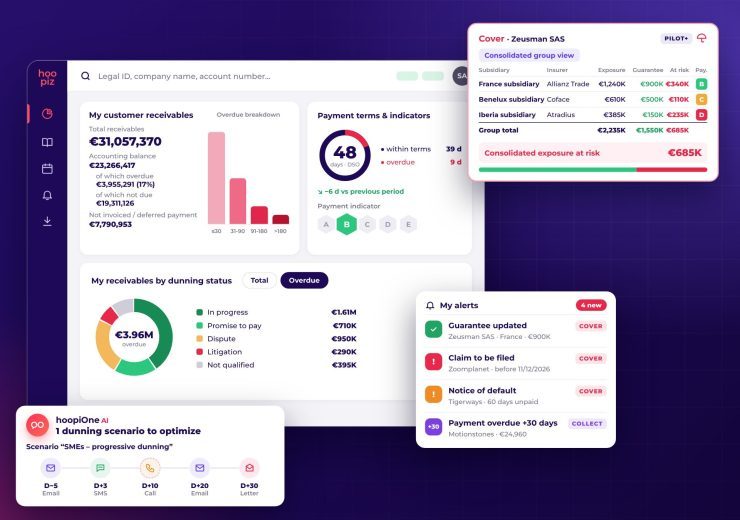
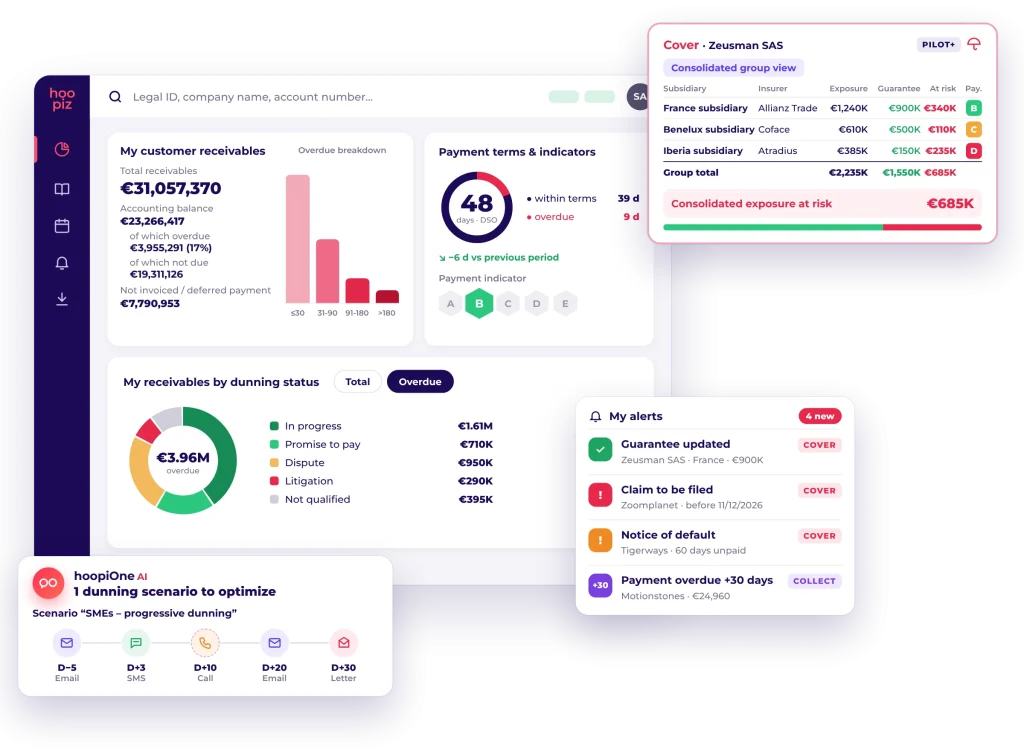
Hoopiz credit management and debt collection software: customer receivables dashboard, dunning statuses, credit insurance alerts, consolidated group view and hoopiOne AI dunning scenarios
France & International

More than 750 companies manage their customer credit with Hoopiz.

We help companies in every sector, including temporary staffing, wholesale and manufacturing, secure their revenue, transform their accounts receivable and optimize payment times, turning them into powerful levers of financial performance.

Hoopiz is also recommended by brokers specializing in credit insurance and receivables management.

Better KPIs & fast ROIMeasurable results on your receivables
−30%

in bad debt

−10 days

in average payment time (DSO)

€2.7M

in cash released per €100M of revenue

−30%

in processing time

Typical results observed among our mid-sized and large corporate customers after 12 months of use; results vary depending on the starting point.

NEW · hoopiOne AI

The full power of Credit Management. Augmented by AI.

hoopiOne adds new artificial intelligence capabilities to Hoopiz, activated according to each organization’s needs and maturity.

Anticipate

See earlier what may affect cash or risk, before an incident occurs.

Decide

Query your receivables in natural language and get a contextual, ready-to-use answer.

Act

Focus your teams on the actions with the greatest impact.

Talk to your Data

Today: multiple searches, filters and analyses.With hoopiOne: one question.

QO
hoopiOneCOMMAND CENTER
Scope: all companies · EURJL
✦

Hello, I’m hoopiOne. Ask me a question about your receivables: I cross-reference outstanding amounts, risk, guarantees and disputes to answer you.

Customers to watchUncovered exposureCollection forecast
Ask a question about your receivables…
→

hoopiOne interface preview · sample data

hoopiOne does not replace the Credit Manager’s judgment: it frees up time for analysis and high-stakes decisions. Gradual rollout from January 2027.

A shared cash culture

Designed for the finance team, useful across the company.

Cash is everyone’s business. Hoopiz gives the finance team control over accounts receivable, and every team the information it needs to contribute.

Finance team

Control of DSO and working capital, reliable consolidated KPIs and automated reporting to steer cash.

Credit Manager

Proactive view of risk and automated monitoring of credit limits.

Collections

Prioritized, automated dunning and structured follow-up of actions.

Sales & order admin

High-value customers identified, disputes resolved faster.

Treasury

Better cash collection forecasting.

Modular, all-in-one solution

Complete Credit Management, activated at your own pace.

Effective collections are part of end-to-end order-to-cash management, starting with data analysis. Brought together in a single platform, Hoopiz modules cross-reference their information and adapt to even the most complex receivables: multi-company, multi-currency and multilingual.

PILOT

Receivables steering & reporting

Interactive dashboards, dynamic aged balance, alerts and payer profiles to turn your data into priorities.

PILOT+ option: group-wide consolidation of exposure and risk.
COLLECT

Collections & disputes

Tailored dunning scenarios, automated emails and text messages, dynamic agenda, collaborative dispute management and order blocking. Discover our debt collection software →

RISK

Risk assessment & monitoring

External financial information, internal credit limits, guarantees and alerts on changes in your customers’ risk.

COVER

Credit insurance

Reconciliation of guarantees and exposure, across contracts and insurers, with alerts on your policy obligations.

CONNECT

API services

Embed Credit Management decisions in your ERP, CRM and BI tools, and automate your data flows.

Hoopiz by sector: staffing · wholesale distribution · food & beverage · building materials · manufacturing · all sectors

What makes the difference

More than dunning software: end-to-end Credit Management.

Designed by Credit Management experts, Hoopiz uncovers what dunning tools and ERP modules miss.

Behavioral scoring

Spot customers who are solvent but pay late. Our scoring is based on actual observed payment delays and complements the ratings of insurers and data providers.

Actively managed credit insurance

Exposure and guarantees reconciled automatically, alerts on overruns, non-payment notifications and claims: your insured receivables stay insured.

Recommended by specialist credit insurance brokers

Groups & multi-entity

Consolidated exposure on a customer shared by several subsidiaries, across insurers and currencies: a group view with no blind spots.

CONNECT

Credit Management at the heart of your information system

Hoopiz doesn’t stop at the screen. Through its APIs, Credit Management analyses and decisions feed straight into your applications and automate your flows, end to end.

ANALYSIS→DECISION→ACTION
  • Automatic blocking and unblocking of customer accounts in the ERP
  • Account opening with built-in risk checks
  • Credit limit approval workflows
  • Risk and collection data delivered to your CRM and BI tools
SaaS solution

Connected Credit Management

Hoopiz works with every information system and connects seamlessly to your entire financial and application ecosystem.

Our many connectors let you centralize data and steer your financial information, credit protection, collection and financing services.

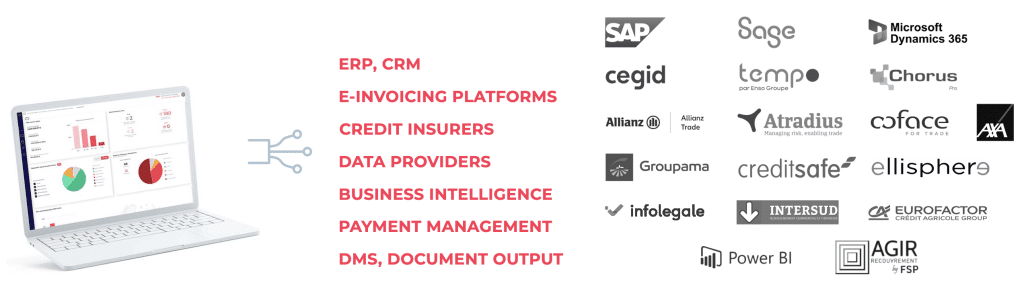
Hoopiz connectors: ERP, CRM, e-invoicing platforms, credit insurers, data providers, BI, payment management, DMS

More connectors are available. Contact us.

Method & support

Sustainable Credit Management, steered together.

Even the most powerful tool only delivers its full potential with strategic support. Our priority remains what matters most: people.

01

Analyze your challenges

Review of your accounts receivable and estimate of the achievable financial and productivity gains.

02

Deploy

A methodology combining business expertise and rigorous project management.

03

Drive performance

Steering committees bring together your credit manager and a Hoopiz project lead, an expert in Credit Management, to optimize your credit cycle over the long term.

This approach builds on the recognized expertise of the solution’s founders, with one clear goal: giving you the best levers for financial and productivity gains.

Security & data protectionInfrastructure and security built for large-scale projects, a decisive factor in the major corporate tenders we have won.
  • Hosted in the European Union
  • TLS 1.2+ and AES-256 encryption
  • SSO SAML / OIDC & MFA
  • GDPR compliant
  • Backups on separate servers
  • Secure OAuth2 APIs

FAQ

Hoopiz answers your questions

Deployment, integration, security, pricing… Answers to the questions finance teams and credit managers ask.

Ask your questions by video callSee all questions →
My ERP already has dunning features: why a Credit Management software?

ERP modules are usually limited to sending reminders. Hoopiz is true Credit Management software: it brings risk, exposure, payment behavior, credit insurance and collections together in a single platform, with tailored dunning scenarios, dispute management and KPI-driven steering. Expected results are higher, and so are the options for organizing your teams. Your ERP remains your accounting system of record: Hoopiz connects to it.

Our organization is complex (group, international, multiple insurers): is Hoopiz a good fit?

Yes, that is precisely where Hoopiz makes the difference. The platform is multi-company, multi-currency and multilingual, handles several contracts and credit insurers, and consolidates exposure on a customer shared by several subsidiaries (PILOT+ option). Centralized or decentralized organizations, complex collections (third-party payers, construction sites…) and multiple levels of responsibility are all supported.

Does Hoopiz integrate with our ERP and information system?

Yes. Hoopiz connects to the main ERPs (SAP, Microsoft Dynamics, Sage, Cegid…), document management tools, Chorus Pro and certified e-invoicing platforms. The CONNECT module adds secure APIs and a dedicated SFTP server to automate exchanges with your information system, CRM and BI tools.

Does Hoopiz work with our credit insurer?

Yes. The COVER module supports multiple contracts and insurers, and is connected to Atradius, Allianz Trade, Coface, AXA and Groupama among others. It reconciles guarantees with exposure and alerts you to your policy obligations: overruns, non-payment notifications, claims, approvals about to be reached.

How long does it take to deploy Hoopiz?

For a standard scope, go-live takes 4 to 12 weeks on average: scoping, data flow connection, configuration and testing, then training. For larger projects (many subsidiaries, international, extensive information system), the schedule is built with you during scoping and may be longer. Modules can also be rolled out in stages.

How is pricing structured?

Hoopiz is offered as an annual subscription, sized to your scope (number of companies, volume of active customers, number of users, modules activated), plus a one-off setup fee. Support and Customer Success are included. We prepare a tailored proposal after an initial conversation.

Take action

How much cash is sleeping in your receivables?

Talk to a Credit Management expert by video call to review your challenges and identify your levers for gains. No commitment.

Read More
7 December 2023

Form sent

We have received your request

Thank you for contacting us. Our team will get back to you as soon as possible!

Read More
3 August 2023

Pricing

Hoopiz › Pricing

Pricing

Hoopiz pricing: a proposal built around your scope

Hoopiz is a modular annual subscription. Since every accounts receivable function is different (number of companies, customer volume, organisation, useful modules), we build your proposal with you, after a conversation with a Credit Management expert.

How pricing works

You pay for your scope, not for a standard package

Your annual subscription depends on four elements. You choose them, and you can change them over time.

Companies to equip

One entity or a whole group, in France and internationally, multi-currency.

Active customers

The number of customers tracked in your receivables.

Users

Credit managers, accounts receivable, sales administration, sales: each with their own rights.

Modules activated

PILOT, COLLECT, RISK, COVER, CONNECT: only the ones you need.

Plus a fixed set-up fee

A one-off fee, defined according to your scope, covers the start of the project with a Credit Management expert.

ScopingData flow connectionConfiguration & testingTrainingGo-live support

Always included

A subscription that includes support

SupportA dedicated team for the configuration, use and operation of the platform.
Customer SuccessOngoing follow-up to make sure your teams get the most out of Hoopiz.
UpdatesPlatform updates and new features.
SecurityHosting in the European Union, backups and GDPR compliance.

Modular

Start with the essentials, activate the rest at your own pace

Start with the modules that matter most to your organisation, then add the others when you need them. Your subscription grows with you.

Pricing request

Get a proposal tailored to your receivables

We don’t publish a price list: each proposal is built on your real scope and presented by an expert.

  1. You describe your contextA few details about your company and your needs.
  2. An expert calls you backTo confirm your needs and clarify your scope.
  3. We present your proposalTailor-made, and walked through with you.

Would you rather see the platform first? Book a demo.


FAQ

Hoopiz pricing: your questions

More questions? See our full FAQ.

Why doesn’t Hoopiz publish its prices?

Because pricing depends on your scope: number of companies, active customers, users and modules activated. A standard price list would be misleading; we prefer to build a fair proposal after talking with you.

How is the subscription structured?

Hoopiz is an annual subscription sized to your scope, plus a set-up fee. Support and Customer Success are included.

How much does set-up cost?

The set-up fee depends on your scope and your data flows (ERP, credit insurers, data providers). It is specified in your proposal, after analysing your needs.

Can we start with a single module?

Yes. Hoopiz is modular: you start with the priority modules and activate the others later, at your own pace.

Is Hoopiz suited to the size of our company?

Hoopiz equips SMEs, mid-sized companies and groups. The conversation with an expert lets us check together that the platform fits your customer volume and organisation.

Is support included?

Yes. Support and Customer Success are included in the subscription.

Let’s build your proposal

A Credit Management expert analyses your challenges and presents a proposal tailored to your scope.

Read More
3 August 2023

Who is Hoopiz?

Hoopiz › Resources › Who is Hoopiz?

Who is Hoopiz?

A Credit Management software publisher with deep expertise, helping companies get paid

Since 2019, Hoopiz has designed and deployed an all-in-one Credit Management platform for SMEs, mid-sized companies and groups. What makes us different: software imagined, configured and supported by people who have made customer credit their profession.

🏆 1st Innovation Award, AFDCC 2024750+ companies equipped30 years of expertiseA team of more than 20 peopleRecommended by credit insurance brokers

Our mission

Turning accounts receivable into a performance lever

Late payments are no longer a passing phenomenon: they weigh durably on companies’ cash, working capital and results. Our conviction: bad debt is not inevitable. It can be prevented, steered and reduced, provided you have the right tools and a real cash culture.

Our ideal: seeing the finance department and the sales department work from the same data, to sell safely and get paid faster.

A software publisher with consulting DNA

More than 20 experts behind every feature

Hoopiz was not born in a tech lab, but in the field of customer credit. Our team of more than 20 people brings together strongly Credit Management-oriented profiles, Customer Success Managers, a support team, developers and sales people. The result: software that speaks the language of credit managers and CFOs, and people who understand your challenges, from the first conversation to day-to-day follow-up.

20+people dedicated to your accounts receivable

Credit Management expertsPractitioners of customer risk, credit insurance, dunning and collections.
Customer SuccessCSMs and project managers who deploy Hoopiz and steer performance with you.
SupportA dedicated team answering your users every day.
Development, data & AIDevelopers building the platform and hoopiOne, the AI for Credit Management.
SalesPeople who know the profession and present Hoopiz based on your challenges.

Our founder

A passion turned into software

Christophe Goffinon, CEO and co-founder of Hoopiz

Christophe Goffinon

CEO & co-founder of Hoopiz

Hoopiz is the tool he dreamed of having when he was credit manager of a large group.

Customer credit has been Christophe’s passion for more than 30 years. As credit manager of a large group, he experienced first-hand what many teams still live with: information scattered between accounting, sales and the credit insurer, spreadsheets consolidated by hand, and too little time to anticipate. He was already dreaming of a tool that would bring it all together.

He went on to run several specialised firms, build collection teams and co-create the first Credit Management software solutions. His career has taken him to the cement group Vicat, Arthur Andersen, Sidetrade and TheoFinance.

With Hoopiz, he finally built that tool: a platform designed by a credit manager, for credit managers and finance departments. Generating cash by optimising accounts receivable remains his driving force, and it is now the DNA of a team of more than 20 people.

A member of the AFDCC (the French association of credit managers) since the 1990s and a long-standing board member, he is committed to promoting good practices for preventing risk and securing accounts receivable as widely as possible.

Follow Christophe on LinkedIn →

Our story

From field expertise to AI for Credit Management

30 yearsOf expertiseCredit management, advisory, collections and the first software solutions on the market: the experience behind Hoopiz.
2019Hoopiz is launchedAn all-in-one platform connected to a complete ecosystem: financial information, credit insurance, collections, factoring.
20241st AFDCC Innovation AwardRecognition from the profession at the AFDCC Innovation Day.
2027hoopiOne AIProgressive rollout of the platform’s artificial intelligence capabilities, from January.

Our values

What drives us

☀️

Enthusiasm

We want to put a smile back on your cash position. Our energy goes into concrete solutions that make teams’ daily work easier.

🚀

Going further

Bad debt is too often seen as inevitable. We want to change that mindset: with the right tools, prevention and anticipation become possible.

🤝

Cooperation

We believe in collective intelligence: between finance and sales, between our customers and our teams, and with the whole Credit Management ecosystem.

Our ecosystem

Committed to the finance community

Hoopiz is an active player in the profession: present at the AFDCC Credit Days, partner of DFCG events, and author of a white paper on Order-to-Cash produced with the support of the DFCG. We work hand in hand with credit insurers, brokers and financial information providers.

Let’s meet

Talk to our experts and see in a demo how Hoopiz can transform your accounts receivable.

Read More
22 February 2021